


Experts agree that, alongside electricity and hydrogen, e-fuels are indispensable for a sustainable energy supply around the world. For example, numerous international experts recently got…
elsenmedia1. January 2023
Global challenges often require complex solutions. The transition of our energy supply to renewable energy may be one of the biggest tasks the world is facing today. Many experts expect that only a mix of different technologies and energy sources will put the world’s energy supply on solid ground while meeting the requirements of climate protection. E-fuels have the potential to contribute a major part to the future energy mix.
But what are e-fuels exactly? How are e-fuels produced and how do they work? What does the carbon footprint of e-fuels look like? Are e-fuels compatible with all internal combustion engines and can they be distributed via the existing fuel stations? eFUEL-TODAY provides comprehensive information on synthetic and renewable fuels.
E-fuels are synthetically produced fuels using energy from renewable sources. Explained in simplified form: hydrogen produced by using renewable electricity is combined with carbon dioxide captured from the air or from industrial sources to form gaseous or liquid hydrocarbons, which are the basic element of fuel. If the CO2 is captured from the air or from biogenic sources, combustion releases, in balance, only the amount of CO2 that was previously captured. Emissions from production and transport are not included in this balance.
Power-to-X (PtX) has become established as the umbrella term for the production process; for liquid fuels the term Power-to-Liquid (PtL) is used. Related, but based on biomass instead of electricity, are Biomass-to-Liquid fuels (BtL). In addition, e-fuels do not require cultivated biomass as feedstock.


E-fuels have the potential to become an important building block of an energy supply based on renewable energy. One of the most significant reasons for e-fuels is that not only the existing cars but also the already established infrastructure of production, supply and storage of energy can continue to be used. Besides that, liquid energy carriers are still the easiest way to store energy with low losses over a longer period of time and to transport it over long distances.
In aviation and shipping, e-fuels even offer an almost unrivaled perspective, since electric drives are subject to certain technical and physical limitations there. Achieving climate targets will require a mix of different technologies, in which e-fuels can be a central building block.
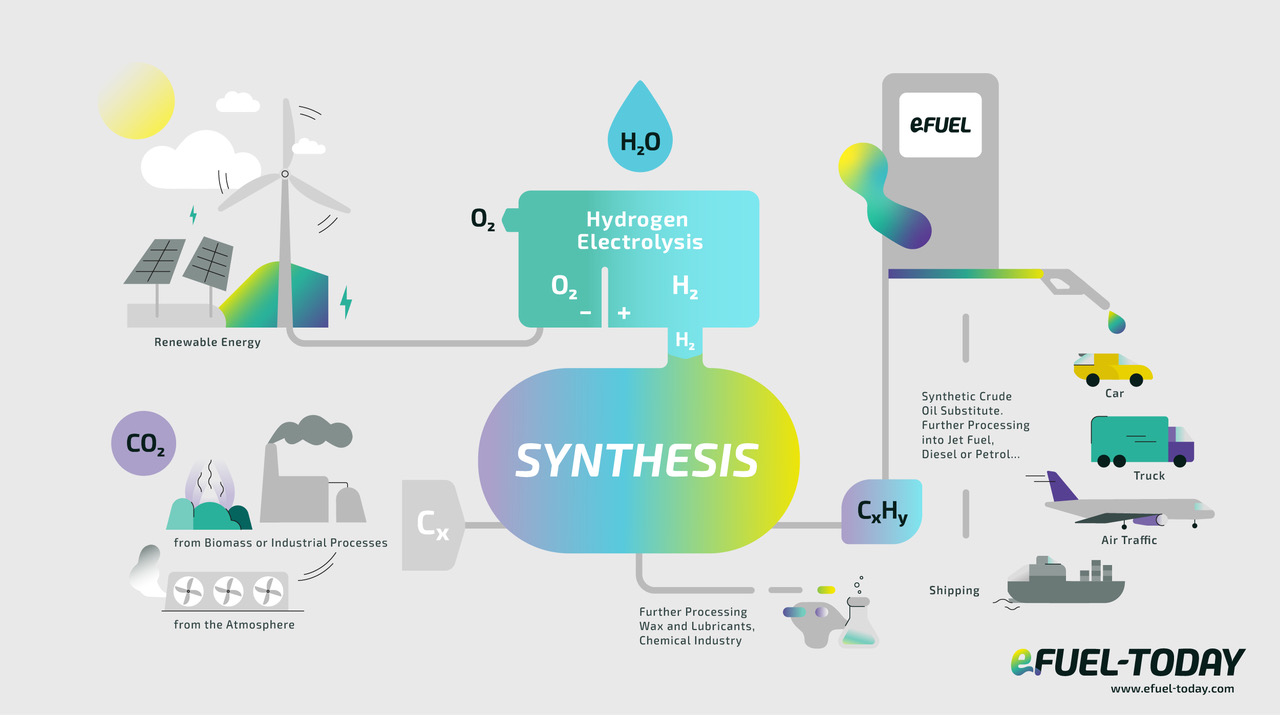
The principle of e-fuel production is easy to explain. In general, e-fuels are made from water and carbon dioxide, and no fossil oil is required. During the production process, the chemical molecules of fossil crude oil are reproduced. The result is a synthetic crude oil substitute that can afterwards be processed into common diesel or petrol fuels.
There are several different procedures to make e-fuels. First, the production of e-fuels requires hydrogen, which is gained through electrolysis from water. The electrolysis uses electricity from renewable sources (such as wind or solar energy). A common method to produce e-fuels is the Fischer-Tropsch synthesis. In this process, hydrogen is chemically combined with carbon (gained from carbon dioxide) and synthesized into a liquid fuel. Besides that, there is another route via methanol synthesis. There are different ways to produce synthetic diesel, jet fuel or petrol components. The illustration shows this in a schematic way:

The industry is ready and several smaller production plants are preparing for the market ramp-up. When e-fuels will be widely available at fuel stations depends on how quickly production capacities are expanded. eFUEL-TODAY regularly reports on the latest developments in the availability of e-fuels.
E-fuels are produced synthetically and they are tailor-made to the specific area of application. Producers of e-fuels describe this new generation of fuels as a crude oil substitute which is processed as usual in the refinery process and blended with additives afterwards to be used in diesel or petrol engines. E-fuels that comply with the applicable fuel standards (e.g. EN 228 or EN 590) can be used in existing vehicles. Paraffinic diesel fuels according to EN 15940 may only be used in vehicles approved by the manufacturer.
Show that you support E-Fuels and order the official campaign sticker! The stickers are available for free while supplies last. Now available in a new design and multiple languages!

eFUEL-TODAY is the largest platform on the subject of e-fuels and reports on the future of fuels and combustibles.
© 2026 eFUEL-TODAY. Imprint | Privacy Declaration | Contact | Cloud


